
Anzeigen
75% of adults have had an injury in the last five years. Yet, most people train without a plan to avoid injuries.
This guide teaches you about Intelligentes körperliches Training. It’s a smart way to make workout plans. These plans help you perform better every day, reduce injury risk, and make steady progress.
You are the audience: people in the United States who are active and want to learn. You will learn why certain methods work. You will also learn how to use them and measure progress with smart tools.
The article has clear guides, tables, charts, examples, and recommendations for apps and wearables. You will learn how to mix strength, endurance, mobility, and recovery into your training. It will fit your life.
Anzeigen
Wichtigste Erkenntnisse
- Intelligentes körperliches Training blends evidence, tech, and coaching to make workouts more effective.
- Functional training focuses on movements and capacities that transfer to daily tasks and sport.
- Smart fitness training uses data from wearables and apps to personalize load and recovery.
- Personalisierte Trainingspläne reduce injury risk and accelerate consistent progress.
- This tutorial provides templates, charts, and practical steps you can apply right away.
What Is Functional Training and Why It Matters
Functional training makes you better at everyday activities. It helps with lifting groceries, climbing stairs, and carrying a child. It focuses on how well you move, not just looking good.
It’s about training your body to do real tasks. This means doing exercises that are like your daily activities. It makes you stronger and more coordinated.
Defining functional training for everyday performance
Choose exercises that are like your daily tasks. Squats, hip hinges, and carries help your body get stronger. It’s not about fancy equipment, but how well you move.
Using tools to track your progress helps. It shows you how to get better and stay safe.
Research-backed benefits for strength, mobility, and injury prevention
Studies prove that functional training is better than single-joint exercises. It boosts strength, balance, and mobility. It also helps prevent injuries and improves work performance.
Tracking your progress helps you stay on track. It warns you of too much load or bad technique.
Common misconceptions and pitfalls to avoid
Some think functional training is just gimmicks. But it’s about real progress and safety. Don’t overload yourself too soon.
Start with simple exercises and add more slowly. Use tools to track your progress. This keeps you safe and on track.
Principles of Intelligent Physical Training
Intelligentes körperliches Training mixes science with data and plans made just for you. It turns guesses into smart choices. You use wearables, tools, and video to get better and safer.
How data-driven workouts change programming
Data-driven workouts adjust your workout as you go. You can change the weight and how many reps based on how fast you move. It also tracks how hard you’re working each week.
Adjust how hard you work based on your heart rate. Tools and video help you move better. This makes your workouts better and more personal.
Personalization: matching goals, movement patterns, and constraints
Your workouts should match what you want to achieve. First, figure out what you’re good at and what you need to work on. This helps you focus on the right exercises.
Make a plan based on what you want to achieve. Choose exercises that work best for you. If you’re short on time or equipment, have a backup plan. This keeps your workouts effective, no matter what.
Balancing stimulus and recovery with smart metrics
Smart workouts balance how hard you work and how well you recover. Watch your heart rate, sleep, and how you feel. This helps you know when to push harder or take it easy.
Plan your workouts based on how you’re feeling. Do harder workouts when you’re ready, easier ones when you’re not. Look at trends, not just one reading, to avoid overdoing it.
| Metric | What it Shows | How to Use It |
|---|---|---|
| Rep velocity | Load intensity and fatigue within a set | Stop sets at a velocity-loss threshold; auto-adjust load next session |
| HRV trend | Autonomic recovery and readiness | Lower intensity or rest if trend drops for 3+ days; resume normal load when recovered |
| Session RPE / TSS-style load | Cumulative weekly stress | Limit weekly increases to planned percentages; prioritize recovery if load spikes |
| Inertial/video movement score | Technique quality and asymmetry | Swap or regress exercises when scores fall below threshold; add corrective work |
Foundational Movement Patterns You Should Master
Building strong fitness means mastering a few key movements. These movements are the foundation of good fitness training. They help you do daily tasks, sports, and chores better.
Focus on squat, hip hinge, push, pull, gait, and carry. These movements help you in many areas of life. Training them well lowers injury risk and boosts your performance.
Here are some key exercises and tips. They help you improve squatting, hip hinge, pushing, pulling, and gait and carry. These are important for your fitness.
Squat options
Choose a squat type based on your goals and how flexible you are. The goblet squat helps with depth and bracing. A loaded back squat builds strength.
Start with a bodyweight squat if you’re new. Split or Bulgarian split squats help with balance and control.
Common tips: breathe and brace, keep your spine straight, push your knees out, and sit back into your hips. Start with less weight or shorter ranges to keep your form good.
Hip hinge and deadlift mechanics
Work on the hip hinge with kettlebell deadlifts, Romanian deadlifts, and conventional deadlifts. Move your hips first, not your knees, and keep your core tight. The weight should move in a straight line close to your body.
Good hip hinge mechanics reduce back stress and improve sprinting and lifting. Start with light kettlebell deadlifts. Then, move to RDLs for hamstring control, and finally to conventional deadlifts for full strength.
Pushing and pulling balance
Train horizontal push (bench, push-up) and vertical push (overhead press) for balanced shoulders. Pair these with horizontal pull (row) and vertical pull (pull-up) to keep your posture and scapular control.
Don’t overdo it to avoid shoulder problems. Use different grips and angles. Focus on quality reps before adding weight to protect your shoulders and maintain strength.
Gait, carry, and rotational work
Add loaded carries like farmer, suitcase, and rack carries to build tolerance for uneven loads and real-world tasks. Single-leg gait drills and loaded single-leg carries improve balance and hip stability.
Include anti-rotation and rotational patterns like Pallof presses and cable chops to strengthen your core. These exercises help with work and sports performance.
| Pattern | Example Exercises | Primary Benefit | Progression / Regression |
|---|---|---|---|
| Squat variations | Goblet squat, back squat, bodyweight squat, Bulgarian split squat | Leg strength, hip mobility, bilateral and unilateral control | Progress: add load, pause, tempo. Regress: box, reduced depth, support |
| Hip hinge mechanics | Kettlebell deadlift, Romanian deadlift, conventional deadlift | Posterior chain strength, lower-back protection, hip power | Progress: heavier RDLs to conventional deadlift. Regress: kettlebell RDL, hip hinge drills |
| Pushing and pulling | Push-up, bench press, overhead press, row, pull-up | Balanced upper-body strength, scapular control, shoulder health | Progress: weighted variations, tempo, volume. Regress: band-assisted, incline/neutral grip |
| Gait and carry training | Farmer carry, suitcase carry, rack carry, single-leg marches | Core transfer, unilateral strength, real-world load tolerance | Progress: heavier load, longer distance, single-arm carries. Regress: lighter load, shorter walks |
| Rotational control | Pallof press, cable/medicine ball chops, anti-rotation holds | Transverse plane strength, anti-rotation stability, transfer to sport | Progress: increased load or dynamic throws. Regress: isometric holds, reduced resistance |
Designing Personalized Workout Plans
Begin by making a clear plan based on your real needs. A good plan starts with checking how you move, how strong you are, and how long you can go. You also need to test how well you control your body.
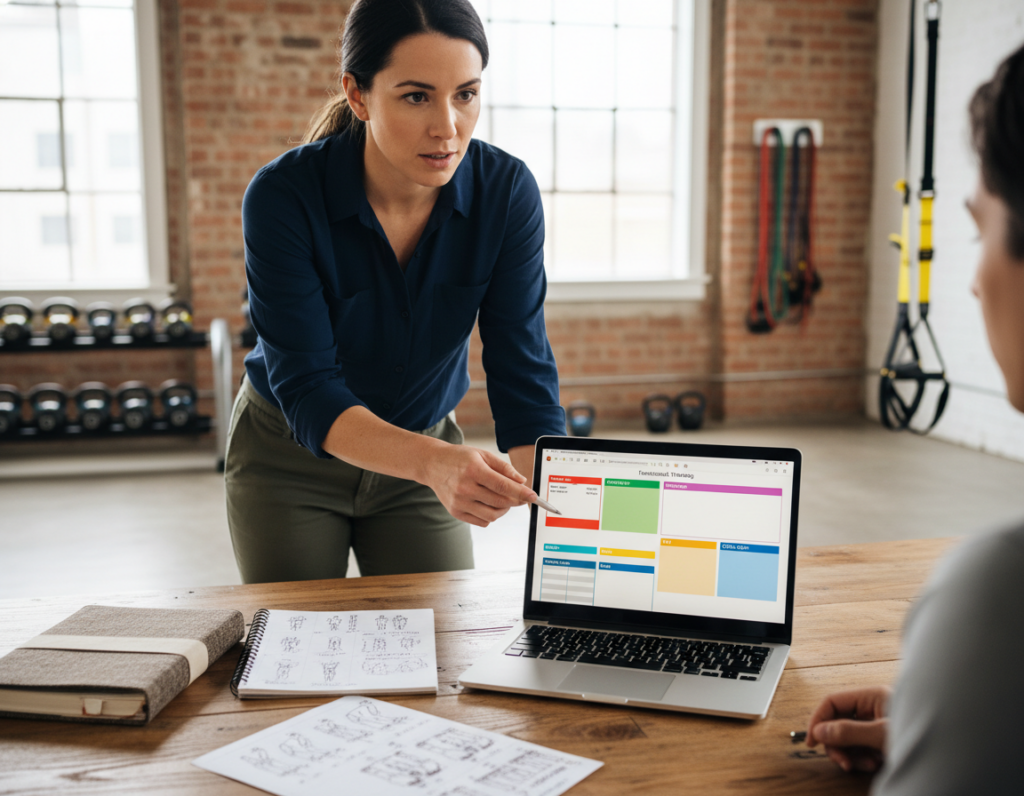
Step-by-step assessment protocol
- Mobility screens: overhead squat screen, ankle dorsiflexion test, hip internal/external rotation.
- Strength tests: 3–5RM or estimated 1RM for squat, deadlift, and press.
- Endurance measures: 5–20 minute time trial or Cooper test as a VO2 proxy.
- Motor-control testing: single-leg balance, single-leg squat, and timed plank hold.
Then, turn your results into goals that you really want. Make sure your goals are clear, measurable, and achievable. For example, you might want to lift 10% more in 12 weeks.
How to prioritize and sequence
- Target strength first if raw force is the main limiter.
- Target endurance first if aerobic base blocks high-quality strength work.
- Use short hybrid phases to maintain both when neither can be ignored.
Now, make a plan for each week and month. Decide how often and how hard you will train. Beginners should train 2–3 times a week, while more advanced people might train 4–5 times.
Training intensity zones and recovery
- Strength: heavy (85%+ 1RM), moderate (70–85%), technique (50–70%).
- Conditioning: low-effort aerobic, tempo, and high-intensity intervals.
- Recovery: full rest days plus active mobility and soft-tissue work guided by smart fitness tracking.
Below are sample templates you can adapt based on your baseline assessment and goals.
| Week Type | 3-Day Template | 4-Day Template | 5-Day Template |
|---|---|---|---|
| Fokus | Full-body strength + mobility | Upper/lower split with conditioning | Strength, conditioning, targeted mobility |
| Sample Layout | Day 1: Strength (heavy), Day 2: Rest/mobility, Day 3: Strength (moderate) + short conditioning | Day 1: Upper heavy, Day 2: Lower heavy, Day 3: Conditioning + mobility, Day 4: Upper/lower accessory | Day 1: Strength heavy, Day 2: Conditioning intervals, Day 3: Active recovery, Day 4: Strength speed work, Day 5: Conditioning endurance |
| Intensity Mix | 1 heavy, 1 moderate, 1 low-technique | 2 heavy/moderate, 1 conditioning, 1 accessory | 2 strength, 2 conditioning, 1 mobility/recovery |
| Recovery Days | 2 rest/active recovery days | 1 full rest, 1 active recovery | 1 full rest, 1 light active recovery |
Use your baseline to set your starting points. Test yourself every 4–8 weeks and adjust your plan. Use smart fitness tracking to keep an eye on your progress.
Keep your plans flexible. If you’re not balanced, reduce the weight and focus on technique. If you’re not recovering well, ease up on the intensity.
Follow these steps to create workout plans that fit your current level, goals, and feedback.
Periodization and Progression That Actually Work
Use structured cycles to shape long-term gains without burning out. Periodisierung gives you a timeline. It has longer blocks to build a base, medium blocks to specialize, and short blocks to fine-tune.
Intelligent Physical Training ties those timelines to data. This way, you can adapt when life or recovery alters the plan.
Macro, meso, and micro cycles explained
A macrocycle is 6–12 months long. It maps big goals like a race or a seasonal shift. A mesocycle is 4–12 weeks and focuses on building a specific quality.
A microcycle is one week. It organizes daily training stress and recovery. Each level has a purpose: build base, specialize, peak, and recover.
Keep plans flexible. Use objective metrics and subjective feedback to change phase length when needed.
Progression charts for strength, endurance, and power
Create simple progression charts to track trends. For strength, plan linear load increases. Use rep ranges of 3–6 for maximal strength and 6–12 for hypertrophy.
For endurance, raise time or intensity by about 5–10% per week. For power, focus on velocity, low volume, and high intent.
| Quality | Typical Rep/Time Range | Weekly Progress Guideline | Intermediate Rate |
|---|---|---|---|
| Stärke | 3–6 reps | Increase load 2–5% for small lifts | 2–4% strength gain per mesocycle |
| Hypertrophy | 6–12 reps | Add volume or load 2–5% weekly when safe | 3–6% size gain per mesocycle |
| Ausdauer | 20–120+ minutes | Increase time or intensity 5–10% weekly | Small steady improvements over months |
| Power | 1–5 reps, high velocity | Maintain intensity, vary volume low | Neuromuscular gains in short blocks |
Plot these trends on progression charts. Show weekly load, volume, and intensity. Use the charts to spot plateaus and to decide when to deload or shift focus.
Planning deloads, peaks, and sustainable load increases
Schedule deloads every 3–6 weeks or use autoregulation. Use readiness measures like sleep, soreness, and performance. For planned peaks, taper volume while keeping intensity up.
Keep recovery inputs high during the taper. Sustainable progression favors small, consistent steps. Target 2–5% weekly increases for accessory and small lifts, slower rates for major compound lifts.
When you combine clear cycles with progression charts and Intelligent Physical Training feedback, you create a system that supports steady gains and sustainable progression. Adjust often, keep charts honest, and prioritize recovery as part of the plan.
Smart Exercise Routines Using Technology
Smart fitness tech turns data into clear cues for every workout. It gives you facts on load, recovery, and how well you move. This makes choosing your routine easier.
Wearables and apps track your daily readiness and training load. Whoop and Oura focus on recovery and HRV trends for rest and sleep. Garmin and Polar give heart rate, training load, and effect for workouts.
Coach’s Eye and smartphone apps let you capture technique and compare frames. PUSH and GymAware measure rep velocity and power for strength sessions.
Each product has its strengths and limits. Whoop and Oura are great for recovery trends but lack velocity data. Garmin and Polar track heart rate well but differ in power metrics.
PUSH and GymAware give accurate rep-velocity training metrics. Smartphone video is affordable but depends on camera angle and frame rate.
Rep-velocity training changes how you pick loads. VBT uses bar or sensor speed to choose intensity and stop sets before too much fatigue. Use velocity loss thresholds to keep quality high and build endurance.
Heart-rate variability and resting heart rate show daily readiness. Look for trends over days and weeks. A single reading doesn’t mean you need to change your training.
Video analysis helps correct technique with low overhead. Record sets, review slow-motion clips, and mark issues. A simple workflow: record baseline, annotate, compare, then correct in the next workout.
Remember privacy and security. Many apps store videos and sensor logs on cloud platforms. Read permissions, limit sharing, and use local storage when possible.
Choose tech based on your budget and goals. A smartphone app is good for basic feedback. For precise load control, invest in PUSH, GymAware, or a force-plate system.
Practical setup tips: sync devices to a single app, standardize camera placement, and use consistent warm-up loads. Log notes about effort alongside metrics to keep human judgment central.
Strength, Endurance, Mobility, and Recovery Integrated
Mixing strength and endurance with mobility and recovery makes you strong and flexible. Use a good order, focus on mobility, and take care of your body to keep moving forward. This way, you avoid getting stuck.
When you mix strength and endurance, put strength first on important days. If you can’t separate them, wait at least six hours. Doing light exercises on strength days helps you stay strong without losing endurance.
When you need both strength and endurance, spread them out through the week. Alternate between heavy strength days and endurance days. Make sure one day is your best effort. Use less work to avoid getting too tired.
Doing a little bit of mobility every day helps you move better and recover faster. Start with a quick warm-up before you work out. Then, do some soft-tissue work after. Add exercises like slow curls and lunges a few times a week to get stronger.
Drills that help your brain control your body are important. Try single-leg carries, slow chops, and tempo squats. Make sure your mobility work is short, specific, and done often.
Getting enough sleep and eating right are key to recovering. Try to sleep 7 to 9 hours and keep your sleep routine the same. Eat protein at every meal and add extra after hard workouts to help your body fix itself.
Drinking water and doing light activities on easy days helps you get ready for the next day. Use easy bike rides or gentle walks on rest days. Tools like compression or cold water can help with soreness, but only use them when you really need them.
Watch your recovery numbers to decide how hard to work. Keep an eye on your heart rate and sleep. If your heart rate goes down or you don’t sleep well for two nights, take it easier. Eat more protein on strength days and do mobility work when you’re tired.
Use data to make your workout choices. Look at your heart rate, how hard you feel you’re working, and your sleep. Making small changes based on facts helps you stay on track without guessing.
Programming Intelligent Exercise Sessions
Good programming turns intent into progress. Use templates that match your time, goals, and tools so you can keep consistency. These templates pair well with intelligente Trainingsprogramme and rely on objective feedback to keep you honest.

20–30 minute high-intent
Target: strength focus with a metabolic finisher. Start with 2 compound movements—3 sets each—at 70–80% of your 1RM. Finish with a 6–8 minute AMRAP or EMOM to build work capacity. This is ideal when you need time-efficient workouts that still drive adaptation.
45–60 minute full session
Target: balanced strength, conditioning, and mobility. Warm-up for 5–8 minutes, complete a 3–5 set main strength block at prescribed intensity, add 2 accessory sets, then a short conditioning finisher and a mobility cool-down. This template suits most athletes and supports data-driven workouts.
75–90 minute advanced session
Target: technique, higher volume, and structured conditioning. Include skill drills, multiple strength blocks with varied intensities, and longer conditioning segments. Use this when you can prioritize recovery and detailed load management.
Managing intensity and density
Use percent of 1RM and rep-velocity to set targets. Pair these with session RPE to adjust volume. For density, choose EMOM for technical consistency, AMRAP for work capacity, and circuits for metabolic stress. EMOM suits strength focus with fixed rest. AMRAP favors conditioning and time-efficient workouts. Circuits blend strength and energy system work when you need compact sessions.
Objective cutoffs and auto-regulation
Set velocity or RPE thresholds to stop a set when quality drops. If readiness metrics like HRV or sleep score are low, reduce volume by 20–40% or swap a heavy block for a technique session. Build active recovery into sets with rest-pause, tempo changes, or low-load eccentrics to maintain stimulus without excessive fatigue.
Sample 45-minute full-body session
Warm-up (5–8 min): dynamic mobility and glute activation. Main strength (20 min): back squat 3×5 at 75% 1RM with a concentric velocity target; rest 2–3 minutes between sets. Accessory (10 min): single-leg Romanian deadlift 3×8 each side, controlled tempo. Conditioning finisher (8 min): alternate 30s kettlebell swings and 30s farmer carries for 8 rounds; keep intensity steady. Cool-down (5 min): hip and thoracic mobility drills.
Cues, intensity targets, and recovery windows
For the squat, cue chest tall, drive through the heels, and reach the velocity target on concentric intent. For single-leg RDLs, maintain hip hinge and a slow return. During the finisher, prioritize consistent pace over maximal load. Use 2–3 minutes rest for main lifts, 60–90 seconds for accessories, and minimal transition rest in the finisher to preserve density.
| Template | Dauer | Main Focus | Intensity Tools | Wann verwenden? |
|---|---|---|---|---|
| High-Intent Short | 20–30 min | Compound strength + metabolic finisher | %1RM, session RPE | Busy days, maintain strength |
| Balanced Full | 45–60 min | Strength, conditioning, mobility | Rep-velocity, RPE, HRV checks | Most training weeks |
| Advanced Volume | 75–90 min | Technique, higher volume, conditioning | Velocity zones, autoregulated volume | Prep blocks, peak phases |
Periodized Example Plans and Visual Progression Charts
Here are some easy-to-use templates for you. Each plan links clear weekly goals with measurable load and mobility targets. Use these plans to guide your Intelligent Physical Training and create workout plans that fit your schedule and recovery.
12-week strength and mobility block (overview)
Weeks 1–4: Start with hypertrophy and daily mobility. Train 3–4 times a week. Focus on improving movement quality and volume.
Weeks 5–8: Now focus on strength. Use lower rep ranges and higher intensity. Keep mobility at moderate frequency.
Weeks 9–12: Peak and test. Add power work, max-effort testing, and a deload in week 12 to consolidate gains.
| Woche | Fokus | Volume/Load (sets × reps) | Mobility Frequency |
|---|---|---|---|
| 1 | Base – hypertrophy | 3×8–12 per main lift | 4 sessions/week (short daily work) |
| 2 | Base – hypertrophy | 3–4×8–12 | 4 sessions/week |
| 3 | Base – hypertrophy | 4×8–10 | 4 sessions/week |
| 4 | Base – consolidation | 3×8–10 | 5 sessions/week (focus areas) |
| 5 | Strength – ramp | 5×4–6 | 3 sessions/week |
| 6 | Strength – intensity | 5×3–5 | 3 sessions/week |
| 7 | Strength – load peak | 4–5×2–4 | 3 sessions/week |
| 8 | Strength – test week | 3×1–3 (near max) | 3 sessions/week |
| 9 | Power – conversion | 3–5×3–6 explosive reps | 3–4 sessions/week |
| 10 | Power – exposure | 4×3–5 power sets | 3–4 sessions/week |
| 11 | Peak – competition style | 2–3×1–3 (specific testing) | 3 sessions/week |
| 12 | Deload & assessment | Reduced to 40–60% volume | Daily light mobility |
8-week endurance-strength hybrid (overview)
Alternate concentrated microblocks. Increase interval intensity week to week. Keep two strength sessions to preserve force output. Use progression charts to track load, session RPE, and performance markers.
| Woche | Primary Focus | Endurance Work | Strength Sessions |
|---|---|---|---|
| 1 | Base endurance | 3×20–30 min steady at moderate HR | 2× full-body 3×8–10 |
| 2 | Intensity build | 4×6×1 min intervals (hard) | 2× full-body 3×6–8 |
| 3 | Consolidation | 2×30–40 min steady + tempo | 2× 4×5 strength |
| 4 | Intensity spike | 5×4×1.5 min intervals (harder) | 2× 4×4 strength |
| 5 | Recovery & base | Lower volume steady 3×25 min | 2× 3×8–10 |
| 6 | Threshold work | 3×20 min threshold efforts | 2× 4×5 |
| 7 | Peak intensity | 6×3 min VO2-style intervals | 2× 3×3–5 (power focus) |
| 8 | Taper & test | Reduced volume, one high-effort test | 2 light strength sessions |
Suggested progression chart fields
- Training load (weekly sum of tonnage or session minutes)
- Session RPE average per week
- Performance markers (1RM, time trial, power output)
How to read and adjust charts
Look for trends, plateaus, and sudden jumps in training stress. A steady upward line means you’re getting better. Flat lines show you’ve hit a wall. Sudden rises might mean too much load or poor recovery.
Adjust your training by reducing volume by 10–20% if you hit a plateau. Add an extra deload after two weeks of rising soreness or if RPE goes up without performance gains. Go back to base work if technique breaks down or injury risk increases.
Visual formats and tools
Use simple line charts for load and RPE. Stacked bars are good for weekly volume distribution. Annotated calendars highlight peaks and test days. Tools like Excel, Google Sheets, and TrainingPeaks help build charts and manage your training.
Common Mistakes and How to Prevent Them
Staying away from common errors can help you get better faster. This guide will show you the most common mistakes. It also gives tips on how to avoid injuries and get better results.
Chasing novelty over fundamentals
It’s easy to get caught up in trying new things. But, this can make you forget the basics like squats and presses. Sticking to the basics helps you get better and stay safe.
Fix it: stick to a plan for 6–12 weeks. Focus on getting better with each workout. Use simple ways to track your progress before trying new things.
Poor progression, volume spikes, and warm-up failures
Jumping too fast in your workouts can hurt your muscles and tendons. Skipping warm-ups and not improving slowly makes it worse. Too much hard work can hurt your body.
Fix it: change your workout load by 10% each week. Make small, safe gains with microloading. Warm up properly to get your body ready for the workout.
Ignoring recovery metrics and subjective readiness
Not paying attention to how you feel and recover can lead to overtraining. Ignoring these signs can hurt your long-term progress. You don’t need fancy tools to notice when you’re not feeling right.
Fix it: keep a simple journal or use an app to track your sleep and how you feel. Plan breaks every 4–8 weeks. Use your own feelings and performance to decide when to ease up.
Neglecting unilateral balance and movement screening
Many people treat strength, mobility, and endurance as separate things. But, this misses important imbalances and bad movement patterns. Ignoring these can lead to injuries and limit your ability to do everyday tasks.
Fix it: add simple drills for both sides of your body. Use standard checks like single-leg balance and hip hinge to make sure you’re moving right. Mix strength, mobility, and endurance in your workouts to improve your overall movement.
| Common Error | Why it Hurts | Practical Fix |
|---|---|---|
| Chasing novelty | Prevents mastery of core movements and reliable progress | Stick to a 6–12 week core plan; track load and technique |
| Volume/intensity spikes | Overloads tendons and muscles, raises injury risk | Use 10% weekly changes, microloading, and tempo control |
| Poor warm-up | Leaves joints unprepared and performance inconsistent | Implement movement-specific warm-ups before heavy sets |
| Ignoring recovery | Leads to overtraining and stalled gains | Log sleep and HRV, plan deloads, apply autoregulation |
| Neglecting unilateral work | Creates imbalances and limits functional transfer | Add single-leg drills and standard movement screens |
| Isolated programming | Misses integrated performance demands | Combine strength, mobility, and endurance in sessions |
Fixing these problems can help you avoid injuries and get better results. Making small, steady changes in your workouts can help you reach your goals.
Advanced Fitness Technology and Innovative Workout Solutions
The gym floor has changed. Now, you can mix machines, sensors, and software for smarter workouts. This section shows how to use advanced fitness tech and new workout solutions in your plan.
First, look at smart gym training systems from big brands. Tonal, Peloton Strength, Technogym, and Matrix have connected gear. It guides resistance and gives feedback right away. Costs and access differ, so think about what you can afford.
Then, think about AI fitness programs that change based on how you do. Some use machine learning to adjust the workout. Make sure to check how they use your data.
Use wearables and sensors for workouts that get better each week. Track speed, heart rate, and more to decide how hard to work out next. For example, if your bar speed drops a lot, work out less the next time.
Start with one or two tech tools at a time. Try HRV with video feedback or speed sensors with a coaching app. Use the data in your training logs and share it with a coach or friend. Always have a backup plan if the tech doesn’t work.
Below is a table to help you pick tools based on budget, use, and benefits. It shows real vendors and trade-offs to match tools to your needs.
| Vendor / Tool | Primary Use | Key Benefit | Typical Cost Range | Best For |
|---|---|---|---|---|
| Tonal | Connected resistance system | Automated resistance, guided programs | $2,995–$3,500 + subscription | Home users who want compact strength training |
| Peloton Strength | Smart guided strength classes | Structured classes, community features | $1,495–$3,000 + subscription | Users who value live classes and coaching vibe |
| Technogym | Commercial connected equipment | Robust analytics for facilities | $5,000–$20,000 per unit | Gyms and performance centers |
| Matrix | Gym-grade smart machines | Durability and integration with club systems | $3,000–$15,000 per unit | High-traffic facilities seeking reliability |
| Wearables (Garmin, Whoop) | HR, HRV, sleep tracking | Daily readiness and recovery metrics | $120–$400 + subscription | Athletes tracking recovery and workload |
| Velocity sensors (Tendo, PUSH) | Bar speed and power metrics | Objective load prescription and fatigue tracking | $200–$500 | Strength athletes and coaches focused on power |
| Video analysis apps (Coach’s Eye, Hudl) | Technique feedback and slow-motion review | Clear visual cues to correct form | $0–$120 per year | Coaches and self-coached lifters |
| Adaptive platforms (AI-driven) | Personalized program generation | Auto-scaling plans based on adherence | $10–$50 per month | Users wanting daily plan tweaks without a coach |
Abschluss
Intelligent Physical Training conclusion: the strongest programs mix evidence-based moves, clear goals, and personal touches. They also include recovery. Focus on basic moves like squats and pushes. This builds strong strength, endurance, and flexibility.
Start by checking your current fitness levels. Then, pick tools that match your budget. Use devices like Whoop for health data. Tools like PUSH help control how hard you’re working.
Plan your workouts for 8–12 weeks. Track how hard you’re working and your heart rate. This helps you adjust your effort.
Think long-term and focus on the basics. Increase your load slowly and treat rest as part of your training. Don’t make the same mistakes over and over.
Use tools like TrainingPeaks to track your progress. Keep your workouts personal and always check how they’re going. This makes your workouts better and more lasting.