Anúncios
Studies and coaches say you can get stronger by 10–30% without getting bigger. This happens when you focus on how your muscles work, not just how big they get.
This guide is about getting stronger without getting bigger. It uses smart training to boost your strength and skills. It keeps your body weight the same.
Science and experts say that how your muscles work is key. This is true even if you don’t get much bigger. Changing how you lift, how fast, and how often helps.
Coaches use this method for powerlifting and getting ready for tough tasks. They focus on technique and lifting heavy weights a few times. This way, you get stronger without getting too big.
This guide is for you to learn how to get stronger without getting too big. You’ll learn about how your body works, how to plan workouts, and how to eat and rest right. It’s all about getting strong for sports, work, or looking good without getting too big.
Anúncios
Key Takeaways
- Strength can rise through neural changes without large muscle size increases.
- Intelligent Physical Training uses load, tempo, and low volume to prioritize force production.
- Strength training without hypertrophy relies on precise metrics like VBT and RPE.
- Personalized workout plans let you target skill and technique over mass gain.
- Coaching frameworks from NSCA and ACSM support strength-focused, non-hypertrophy phases.
Why Choose Strength Gains Without Hypertrophy: Goals and Expectations
You might want to lift heavier without getting bigger. This choice changes how you train, eat, and check your progress. Knowing what you want helps you reach your goals and see how you’re doing without unexpected size changes.
Understanding strength vs. size
Strength is how much force you can make. Size is how big your muscles are. Things like how your muscles work and your tendons affect strength, not always making muscles bigger.
Studies show you can get stronger with less muscle by doing less but more intense workouts. This method helps improve how well you move and use your muscles, not just making them bigger.
Common reasons people avoid hypertrophy
Many athletes and professionals don’t want to get bigger. They need to stay light for their sport. Cyclists and long-distance runners want strong legs without extra weight.
People in tactical jobs and gymnasts need to be agile and quiet. Recreational lifters often like looking lean. For example, long-distance cyclists can pedal harder without getting their legs bigger.
Setting realistic, measurable goals
Make your goals clear and checkable. For instance, aim to lift 8–12% more in your squat in 12 weeks. Keep your weight close to what it is now.
Other good goals are to get stronger relative to your body weight and to improve how fast you can generate force. Set deadlines and track your progress with clear numbers. This way, you can be sure you’re meeting your goals.
At first, you’ll get stronger fast because of how your brain and muscles adapt. Keep an eye on how your body looks and how well you perform. If you start to get bigger or don’t get stronger, change your workout plan. This way, you can keep avoiding getting bigger while still getting stronger.
How Muscle Physiology Lets You Increase Strength Without Large Size
You can get stronger without getting bigger by focusing on the right things. Muscle physiology tells us that getting stronger comes from two main areas. These are changes in the nervous system and how muscles contract.
Short, intense workouts help the nervous system more than the muscles. This is good for getting stronger without getting too big. It works well with smart training plans and data-driven fitness programs.
Neural adaptations explained: motor unit recruitment and rate coding
Your nervous system gets better at making muscles stronger before they get bigger. Heavy workouts use special muscle fibers that help you get stronger. Training makes these fibers work better together.
Training also makes your muscles fire faster. This means you can lift heavier and faster. Studies show this happens quickly and is key to getting stronger early on.
Muscle fiber types and their role in strength-only programming
Muscle fibers are different in how fast they work and how long they can go. Slow fibers are good for endurance, while fast fibers are better for strength. Strength workouts use the fast fibers more.
Working on these fibers makes you stronger without getting too big. Small changes in how fibers are arranged can make a big difference in strength.
Metabolic and endocrine factors that influence hypertrophy
Hypertrophy, or muscle growth, needs the right amount of work and stress. High-rep sets and long workouts raise important hormones. This helps muscles get bigger.
But, too much work can stop muscle growth. Short, intense workouts give a quick boost but don’t keep muscles growing big. It’s all about balance.
So, focus on doing intense workouts, keep the volume in check, and add fast movements. This way, you get stronger without getting too big. Using smart training plans helps you stay on track and avoid unwanted muscle growth.
| Mechanism | What to Emphasize | What to Limit | Expected Result |
|---|---|---|---|
| Neural adaptations | Heavy singles, doubles, explosive sets, technical practice | High-rep fatigue sets | Faster strength gains, improved RFD |
| Fiber type recruitment | Maximal and near-maximal loads, velocity work | Long-duration low-intensity endurance work | Greater Type II efficiency, limited size increase |
| Metabolic/hormonal signaling | Short sessions, controlled sets, calorie maintenance | High-volume metabolic circuits, chronic surplus calories | Reduced hypertrophic signaling, controlled muscle girth |
| Program control | Intelligent Physical Training, objective tracking | Unguided volume increases, subjective guessing | Precision progression via data-driven fitness programs |
Principles of Intelligent Physical Training for Strength-Focused Results
Intelligent Physical Training is a smart way to get stronger. It uses data and how you feel to guide your workouts. You’ll choose exercises based on how fast you lift, how hard you work, and how strong you are.
Why data-driven fitness programs matter for non-hypertrophy goals
Data-driven fitness helps you focus on getting stronger, not just bigger. It tracks how hard you work and how fast you lift. This way, you can see how much you’re improving.
Balancing intensity, volume, and frequency to limit size gains
Use heavy weights for short, hard lifts to boost your strength. Aim for 8-12 heavy sets each week for each muscle group. Lift each exercise 2-3 times a week to get better and stronger.
Choose to lift heavier or faster instead of doing more reps. This way, you get stronger without getting too big.
Using perceived exertion and objective metrics together
Use how hard you feel you’re working and how fast you lift to guide your workouts. Stop when you’re 10-20% slower than usual to avoid getting too tired. This mix helps you stay focused on strength without getting too big.
For example, stop bench presses when you’re 15% slower than usual. This keeps your workouts focused on strength, not size.
| Element | Practical Guideline | Why it helps limit hypertrophy |
|---|---|---|
| Load | ≥85% 1RM for most heavy sets | Promotes neural adaptation with low metabolic drive |
| Volume | 8–12 heavy sets per prime muscle group/week | Enough for strength without crossing typical hypertrophy volume thresholds |
| Frequency | 2–3 sessions per lift per week | Enhances skill and strength while distributing stimulus |
| Autoregulation | Use RPE/RIR plus velocity loss 10–20% | Limits fatigue and metabolic stress that drive size |
| Progression | Increase load, improve technique, or boost bar speed | Maintains progressive overload without adding volume |
| Tracking tools | VBT devices, HRV monitors, force outputs, RPE logs | Provide baselines and trends for smart exercise routines |
| Program design | Iterative, data-informed adjustments | Creates personalized workout plans that respond to your progress |
Designing Personalized Workout Plans That Minimize Hypertrophy
Begin by doing a thorough check-up. Use 1RM or estimated 1RM from VBT, RFD tests, and jump tests. Also, do an isometric mid-thigh pull to measure strength.
Do a body scan like DEXA or bioimpedance to see how you’ve changed. Check again every 6–8 weeks. This way, your workout plans can change with you.
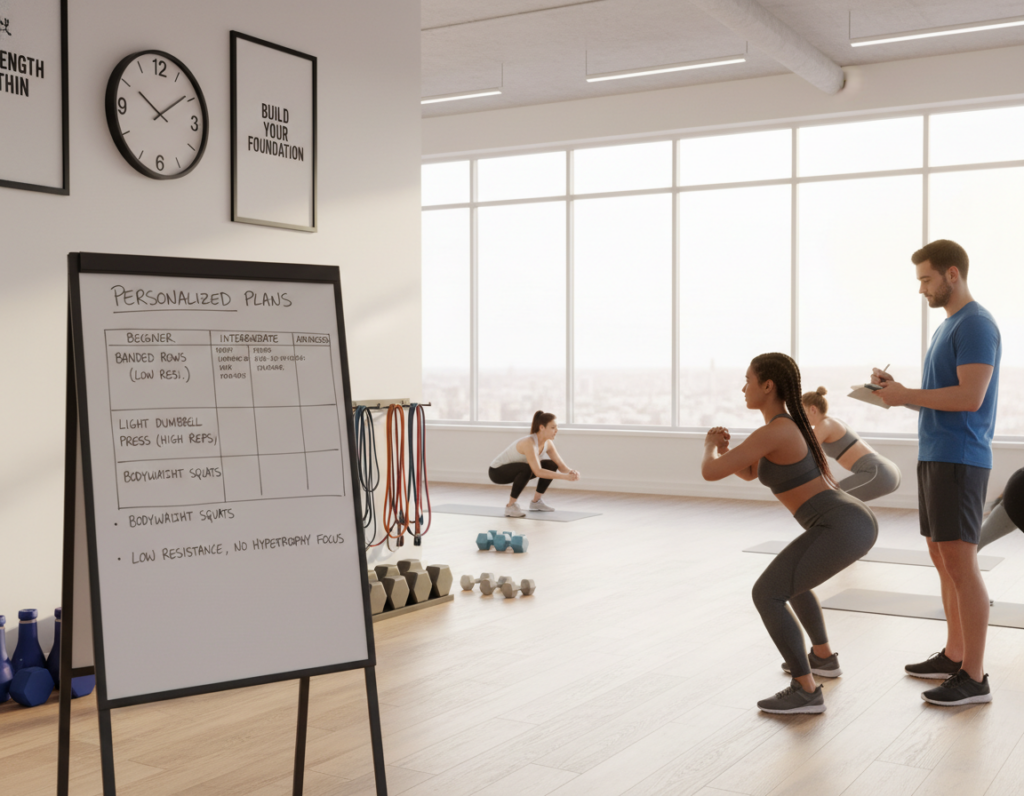
Choose exercises that help you get stronger and better at skills. Focus on big lifts like squats and deadlifts. Add special moves to improve your technique.
Use explosive moves like medicine ball throws to get stronger without getting too big. Avoid machines and high-rep workouts that make muscles bigger.
Sample split templates help you plan a real week.
-
3-day full-body (Mon/Wed/Fri): Focus on heavy squats or deadlifts, and upper body lifts. Add explosive moves daily. Lift main weights at 85–95% 1RM for 3–5 sets of 1–5 reps.
-
4-day upper/lower (Mon/Tue off/Thu/Fri): Do two strength days for each muscle group, one power day, and one recovery day. Keep each workout low to moderate to avoid getting too big.
-
5-day minimalist for athletes: Have two strength days, two sport-specific days, and one recovery day. Focus on skills for your sport.
Make your workout plan fit your life and goals. If you’re not explosive, do more explosive moves. If you’re stiff, do lighter sets to improve your form.
Use smart plans and tools to guide your workouts. Track your progress with VBT and jump tests. This helps you avoid getting too big.
Adjust how often you rest and how many workouts you do. If you’re stressed or eating more, do less. Check your progress every 6–8 weeks to keep your plan right for you.
Smart Exercise Routines: Load, Tempo, and Rest Strategies
You want to get strong without getting too big. Use smart workouts that focus on brain strength, keep time under tension low, and don’t stress your body too much. Choose quality over how much you do when picking loads and resting.
Heavy loads with low to moderate volume for neural strength
Lift heavy weights with short sets to train your brain. Try 5 sets of 3 reps at 85–90% of your max. Do about 6–8 heavy sets a week for your brain to adapt.
Use slow starts, fast lifts, and short times under tension. This helps you get stronger without building too much muscle. It follows the Intelligent Physical Training way of getting strong without too much muscle stress.
Explosive training and potentiation without hypertrophy stimulus
Add explosive moves to boost your power. Do 3–6 sets of 3–6 reps at 30–60% of your max for jumps and throws. Use post-activation potentiation carefully: a heavy lift followed by 2–3 explosive reps.
For example, do a heavy trap bar lift at 90% and then three loaded jump triples. Keep explosive work low to avoid too much stress. Pair it with velocity-based training to keep your lifts fast.
Rest periods and their impact on recovery and muscle growth
Long rests help your ATP-PC system recover and keep your brain strong. Use 2.5–5 minutes between heavy sets for quality repeats. For explosive work, rest 1–2 minutes to keep speed up without getting too tired.
Short-rest, high-volume sessions can stress your body too much. Space out your sets and limit total reps to keep muscle growth small. This is key in Intelligent Physical Training to keep size gains minimal.
Sample strength session
Deadlift: 5×3 @85–90% 1RM, tempo 0-1-X-0, rest 3–4 min, aim for max speed on each rep.
Trap bar loaded jumps: 4×3 @40% 1RM, tempo 0-0-X-0, rest 90 sec, aim for max speed.
Paused Romanian deadlift (accessory): 3×5 @65% 1RM, tempo 2-1-X-0, rest 2 min, keep TUT moderate to avoid too much stress.
Use tools to check your rep speed and adjust your load. If your speeds drop, stop or reduce volume. This keeps your brain gains and muscle signals low.
Periodization Models to Prioritize Strength Over Size
Choosing the right training structure helps you get stronger without getting bigger. Use periodization for strength to organize your workouts. This way, your training plans are based on real progress, not guesses.
Block periodization tailored to limiting hypertrophy
Block periodization divides your training into short blocks. Start with a block that focuses on skill and technique. Keep this phase short and avoid long cardio sessions to prevent getting too big.
Then, move to a block where you do more intense workouts. Focus on heavy lifts and rest well. Finish with a block to peak your strength and cut down on workouts.
Undulating and conjugate approaches for neural emphasis
Weekly undulating periodization changes your load and focus each day. You can do heavy, light, and power days to hit your neural pathways often. Keep your daily workouts moderate.
The conjugate method mixes different types of workouts. Use low-rep sets to avoid getting too big. Change your exercises often to stress your nervous system, not your muscles.
Sample periodization table and progression charts
| Week | Focus | %1RM Target | Volume | Velocity Range (m/s) |
|---|---|---|---|---|
| 1–4 | Technique & neural density | 60–75% | Low to moderate | 0.6–0.9 |
| 5–8 | Maximal strength | 80–95% | Moderate | 0.3–0.6 |
| 9–10 | Taper and peak | 75–90% | Very low | 0.5–0.9 |
| 11–12 | Deload & reassess | 40–65% | Low | 0.8–1.0 |
Keep track of your progress with %1RM targets and velocity. Expect your strength and power to increase during weeks 5–8. Then, see a small peak in 9–10, and a drop during the deload.
Watch your performance, HRV, soreness, and body mass. Plan deloads to avoid fatigue and unwanted size gains. Use Intelligent Physical Training tools to adjust your workouts and keep your strength gains ahead of size.
Integrating Endurance, Mobility, and Recovery Into Strength Plans
Mixing endurance, mobility, and recovery into your strength plan keeps you strong. It also stops unwanted muscle growth. Use smart timing and focus on strength to avoid too much muscle.
Concurrent training can slow down muscle growth. This happens when you add some endurance work. Short cardio sessions are better than long ones for keeping strength up.
Do endurance work more than six hours after strength training. Or do them on different days. This helps keep your strength high.
Daily mobility work makes your lifts better. It stops you from using bad movements that grow too much muscle. Focus on specific joints like hips and ankles.
Short, daily mobility sessions are better than long ones. They help you lift better and avoid injury.
Recovery strategies are key for muscle growth. Sleep well, eat right, and recover to keep your muscles strong. Use tools like wearables to track your recovery.
Wearables help you see how tired you are. This lets you adjust your workouts to stay strong without getting too big.
Do short mobility and recovery sessions twice a week. This keeps your movements right and reduces injury risk. Limit endurance to once a week for more strength without bulk.
Below is a sample week that blends strength, endurance, mobility, and recovery to sustain strength gains while controlling size.
| Day | Morning | Evening | Notes |
|---|---|---|---|
| Monday | Heavy strength: compound lifts (low volume, high load) | Mobility: thoracic rotations, ankle dorsiflexion (15 min) | Priority on strength; short mobility to aid recovery |
| Tuesday | Recovery block: low-intensity cycling (20–30 min) | Soft tissue work: foam rolling (10 min) | Active recovery to limit inflammation and maintain work capacity |
| Wednesday | Explosive strength: plyometrics and potentiation (low reps) | Mobility work: 90/90 hip switches, banded distraction (15 min) | Emphasize power without hypertrophy-driving volume |
| Thursday | Low-impact endurance: short intervals or LISS (25–35 min) | Sleep focus and nutrition: protein timing, maintenance calories | Keep endurance separate from heavy lifts by >6 hours when possible |
| Friday | Strength: accessory neural work, technique sets (moderate load) | Contrast baths or light mobility (10–15 min) | Use targeted accessory work that refines skill, not size |
| Saturday | Off or light walk: active recovery | Wearable review: HRV and sleep data to plan next week | Rest or very light activity to consolidate adaptations |
| Sunday | Full rest: sleep, nutrition at maintenance | Prepare training plan using data-driven fitness programs | Complete recovery day to prevent chronic inflammation |
Smart Gym Equipment and Advanced Fitness Technology for Precision
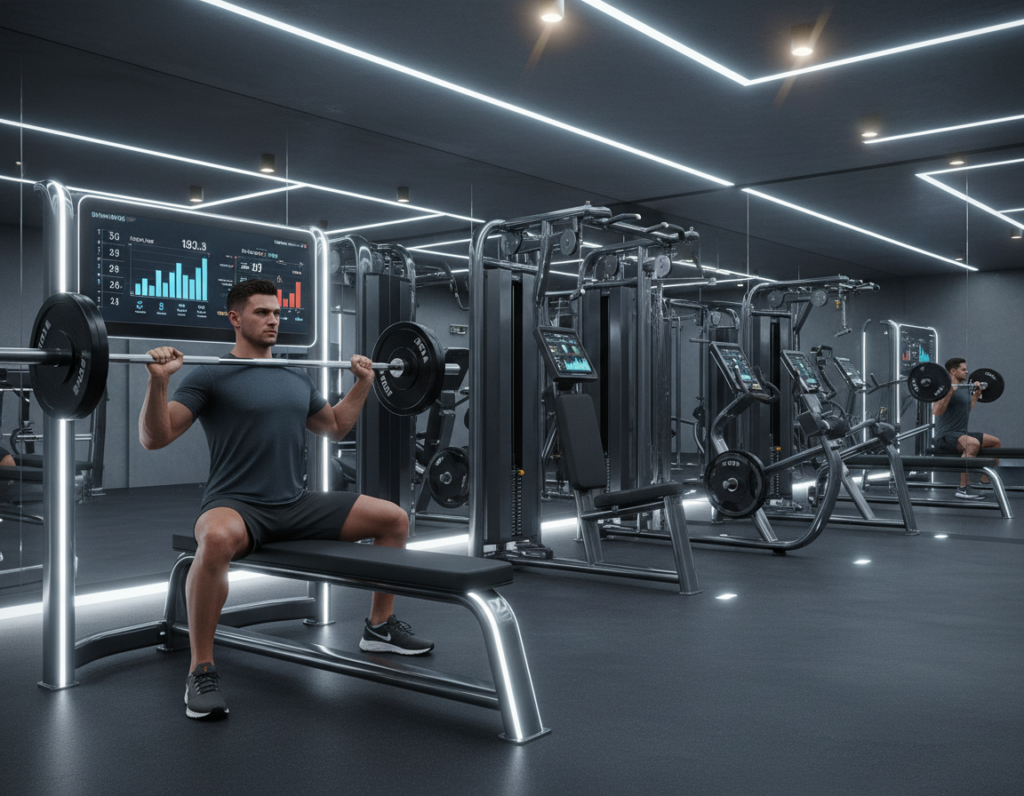
Smart gym tools give you clear data to guide your strength training. Start with simple tests to set your base. Use devices that track bar speed, force, and recovery. This way, your training adapts to your body, not just a chart.
How velocity-based tools help you train for strength
Tools like GymAware, PUSH, and Tendo measure bar speed. They give you feedback right away. First, you set a speed baseline from a few lifts.
Then, you train in specific speed zones. For example, 0.30–0.50 m/s for heavy lifts.
Velocity-based training lets you adjust your training based on how you feel. If your speed drops, stop or lighten the load. If it stays high, add more weight. This method helps avoid too much muscle growth.
Wearables and monitoring tools for neural load and fatigue
Wearables like WHOOP, Oura, and smartwatches track your sleep, heart rate, and daily stress. They show when you’re ready to push harder or take a break. This helps you avoid too much training that can lead to unwanted muscle growth.
Use these tools with session-load trackers to see how your body is doing over time. Small changes can help you stay focused on strength, not just getting bigger.
Using force plates, EMG, and apps to refine stimulus
Force plates measure how fast you can develop force and balance during lifts. EMG systems show which muscles work the most. This helps you focus on the right muscles and avoid overworking others.
Apps like StrengthLog and TeamBuildr help you track all this data in one place. You can adjust your training to meet your strength goals without growing too much.
Here’s a simple plan: start with a baseline test. Do weekly speed checks and daily readiness scans. Use speed loss to control how hard you train. Choose affordable options like phone apps and basic sensors if you’re on a budget.
| Tool | Primary Metric | How it helps limit hypertrophy | Cost tier |
|---|---|---|---|
| GymAware / PUSH / Tendo | Bar velocity (m/s) | Autoregulates load, uses velocity zones and loss thresholds to limit metabolic stimulus | Mid to high |
| WHOOP / Oura / Smartwatch | HRV, sleep, readiness | Guides daily load adjustments to avoid chronic fatigue and compensatory volume | Low to mid |
| Force plates | Rate of force development, asymmetry | Targets neural power and flags imbalances that cause accessory overuse | High (portable options available) |
| EMG systems | Muscle activation patterns | Ensures prime mover dominance, reduces unintended accessory hypertrophy | Mid to high |
| StrengthLog / TeamBuildr | Consolidated session and device data | Centralizes metrics for coach or self-guided autoregulation | Low to mid |
AI-Powered Fitness Coaching and Intelligent Training Tools
You can use AI to keep getting stronger without getting too big. Tools like Trainerize and Freeletics use your past workouts and sleep to set goals. They adjust how hard you work to keep you strong without getting too big.
These tools also change your workout based on how you feel. They look at how fast you lift and how tired you are. This way, you can keep lifting heavy without getting too tired.
These tools help you stay focused on getting stronger. They use special training methods and watch how you recover. This helps you avoid getting too big while staying strong.
Real people have seen great results with these tools. A climber got 10% stronger without gaining weight. Others kept their muscle mass while getting stronger.
When picking tools, look for clear data and coach help. Make sure you can set limits to avoid getting too big. Remember, AI is a helper, not a replacement for your coach or experience.
Here are some steps you can take today:
- Set conservative goals in apps and keep your weekly sets low.
- Use velocity loss thresholds under 15% for strength-focused sets.
- Watch your body mass and 1RM; slow down if mass goes up.
- Use AI feedback and talk to your coach to adjust recovery and nutrition.
Nutrition Strategies to Support Strength Without Bulk
You can boost strength without getting too big. This is done by using smart nutrition. It helps you stay strong without eating too much.
Small diet changes help your body get better. They also help you recover faster.
Calorie management: maintenance vs. surplus and their effects
Your calorie balance affects your body size. Eating more than you burn leads to bigger muscles. But, eating just enough helps you get stronger without getting bigger.
Keep your weight the same each month. Check your weight, how hard you train, and how well you do it every week. Change what you eat a little bit at a time.
Protein timing and quantity to support recovery but limit hypertrophy
Most adults need 1.2–1.6 g of protein per kilogram of body weight. This is for strength, not getting bigger. Older people or those who train a lot might need more, up to 2.0 g/kg.
Eat 20–40 g of good protein every 3–4 hours. This helps you recover. But, don’t eat too much protein at once, especially if you’re eating more calories.
Macronutrient partitioning and supplements that align with your goals
Eat carbs before and after working out. This gives you energy and helps your muscles recover. Eat 20–50 g of carbs at a time. Don’t eat too much fat, but enough to keep your hormones and health good.
Think about taking supplements like creatine for strength. Beta-alanine helps you do more reps, and caffeine boosts your power and focus. But, be careful with creatine because it can make you retain water.
Use body checks to make sure you’re not getting too big. Use tools like DEXA scans or take body measurements and photos. Keep track of how you’re doing with your training and make small changes as needed.
| Meal | Example (70 kg athlete) | Protein | Carbs | Notes |
|---|---|---|---|---|
| Breakfast | 3 eggs, oats, berries | 24 g | 45 g | Even protein spread to start the day |
| Pre-workout | Greek yogurt + banana | 15 g | 30 g | Moderate carbs for training intensity |
| Post-workout | Whey shake + rice cake | 25 g | 30 g | Timely carbs aid performance recovery |
| Dinner | Salmon, sweet potato, greens | 32 g | 40 g | Healthy fats for hormones |
| Evening snack | Cottage cheese + nuts | 18 g | 10 g | Supports overnight repair without excess calories |
Follow this meal plan to stay at maintenance calories. Aim for 1.6 g/kg of protein. Watch how you’re doing and make small changes if needed. This way, you’ll get stronger without getting too big.
Common Mistakes, Injury Prevention, and Troubleshooting Plateaus
When you chase strength without size, small mistakes can lead to unwanted growth. This section talks about common pitfalls, how to prevent injuries, and how to get past plateaus. We use Intelligent Physical Training and smart exercise routines to help.
Training errors that inadvertently cause hypertrophy
Doing too many sets is a common mistake. Long sessions with lots of sets can make muscles grow too much. Cut down on volume and focus on quality sets that help your nervous system.
Doing too many sets to failure can also cause muscle damage. Stop short of failure and use velocity loss limits. This helps keep your neural drive strong and avoids hypertrophy mistakes.
Long time under tension and heavy use of isolation movements can also cause growth. Switch some isolation work for compound, skill-focused lifts. Use Intelligent Physical Training data to watch tempo and avoid long manual cadences that trigger growth.
Recognizing overreaching vs. productive fatigue
Productive fatigue causes short-term drops in performance that rebound after rest. Nonfunctional overreaching and overtraining show persistent declines, poor sleep, mood shifts, higher resting heart rate, and low HRV.
Watch objective markers. Track daily readiness, session velocities, and RPE. If numbers and mood worsen for more than two weeks, move toward planned deloads and reduced volume to recover. Prioritizing sleep and nutrition speeds restoration and supports injury prevention.
Practical fixes and alternative exercises to break plateaus
If you stall, re-test 1RM or velocity baselines to confirm true change. Record technique on video to spot mechanical leaks. Often a technical tweak restores progress faster than more volume.
Change intensity instead of volume. Increase load for core lifts in small increments, then pare back accessories. Try a brief microcycle emphasizing speed/power or an eccentric-light block to refresh the nervous system and aid troubleshooting plateaus.
Substitutions help when accessory work causes size gains. Replace high-rep leg press sets with heavy single-leg Romanian deadlifts that tax balance and motor control. Swap machine isolation for bilateral compound lifts with lower rep ranges to support neural adaptations and avoid hypertrophy mistakes.
Injury prevention and safe progression
Start sessions with progressive warm-ups that move through range of motion, then add mobility drills for joints used in your main lifts. Check movement quality before adding load; poor patterns under weight raise injury risk.
Follow conservative load progression rules. Increase main-lift load by 2.5–5% when velocity and RPE indicate readiness. Use autoregulation within Intelligent Physical Training platforms to modulate weekly stress and limit chronic overload.
Seek professional input when pain or asymmetry persists. Consult a licensed physical therapist or a certified strength coach such as those from the National Strength and Conditioning Association to assess movement, rule out pathology, and design corrective smart exercise routines.
Conclusion
You can get strong without getting big. Focus on how your body adapts and use smart training plans. Heavy, low-volume workouts and careful nutrition are key.
Start with tests to see where you are. Choose a training plan that works for you. Use tools to track your progress and keep it safe.
Change your plan every 6–12 weeks. Watch your strength, speed, and how well you recover. Adding mobility and conditioning helps too. This way, you can get strong without getting too big.